
Gadsden County Court Records After a Jail Arrest
When someone is arrested in Gadsden County, the sheriff or a local police agency books the person into the jail. That is the start, not the finish. The Office of the State Attorney for the Second Judicial Circuit then reviews the law-enforcement information and decides what formal charges to file. Those filed charges open a case, and the case becomes the court record. The clerk keeps that record, and it is searched separately from the jail roster.
It helps to keep the two sides apart. The booking and custody side is covered on the Gadsden County jail inmate records page, and booking photos are handled on the jail roster mugshots page. The court record itself is the charges the prosecutor filed, tracked through hearings to a disposition. An arrest can happen without a charge ever being filed, and the charges a prosecutor files can differ from the booking charges. That is exactly why the court record matters after an arrest.
How to Find Gadsden County Court Records After an Arrest
Formal criminal case records in Gadsden County are searched through the Clerk's CourtScribe Public Inquiry portal. It is free and public. The arrest and booking detail stays on the jail roster, but the charges, hearings, and status live in the court record you pull here.
The Gadsden Clerk CourtScribe public inquiry portal is the court case search for charges filed after an arrest.
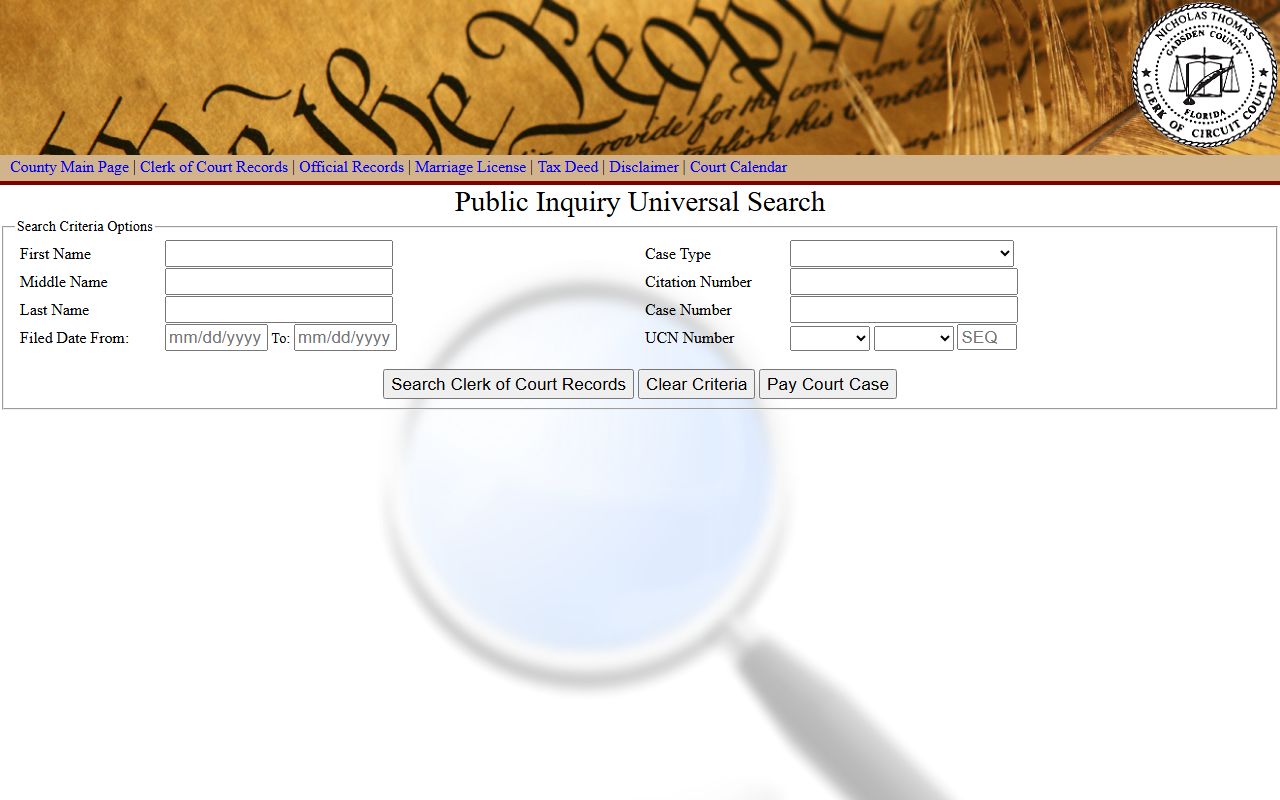
The portal accepts a defendant name, a filed-date range, a case number, or a UCN, which makes it easy to narrow a common name to the right case.
- Open the CourtScribe public inquiry portal.
- Search by the defendant's last and first name, or by case number if you have it.
- Narrow with a filed-date range near the arrest date when many results appear.
- Open the case and read the charge list, the case type, the file date, and the current status.
For a statewide criminal history rather than a single local case, FDLE runs a separate paid search. The FDLE Florida criminal history check posts a 24 dollar search fee and is a repository product, not the live Gadsden docket.
How Charges Get Filed After an Arrest: Complaint, Information, and Indictment
The charge record begins when a charging document is filed. Booking happens at the jail first. Then, depending on the offense and the procedure, the case proceeds by complaint, by information, or by indictment. In Florida, the State Attorney files an information for many felony and misdemeanor prosecutions, while a grand jury returns an indictment in the most serious matters.
| Complaint | Information | Indictment | |
|---|---|---|---|
| Filed By | Officer / Prosecutor | State Attorney | Grand Jury |
| Common For | Early-stage and lower charges | Many felonies and misdemeanors | Serious felonies |
| Starts | The case | The case | The case |
The prosecutor's role is the hinge between the arrest and the court record. The State Attorney for the Second Judicial Circuit is Jack Campbell, and the circuit covers Gadsden along with Leon, Franklin, Jefferson, Liberty, and Wakulla counties.
The State Attorney Gadsden office page lists the Quincy office contacts that handle local prosecutions.
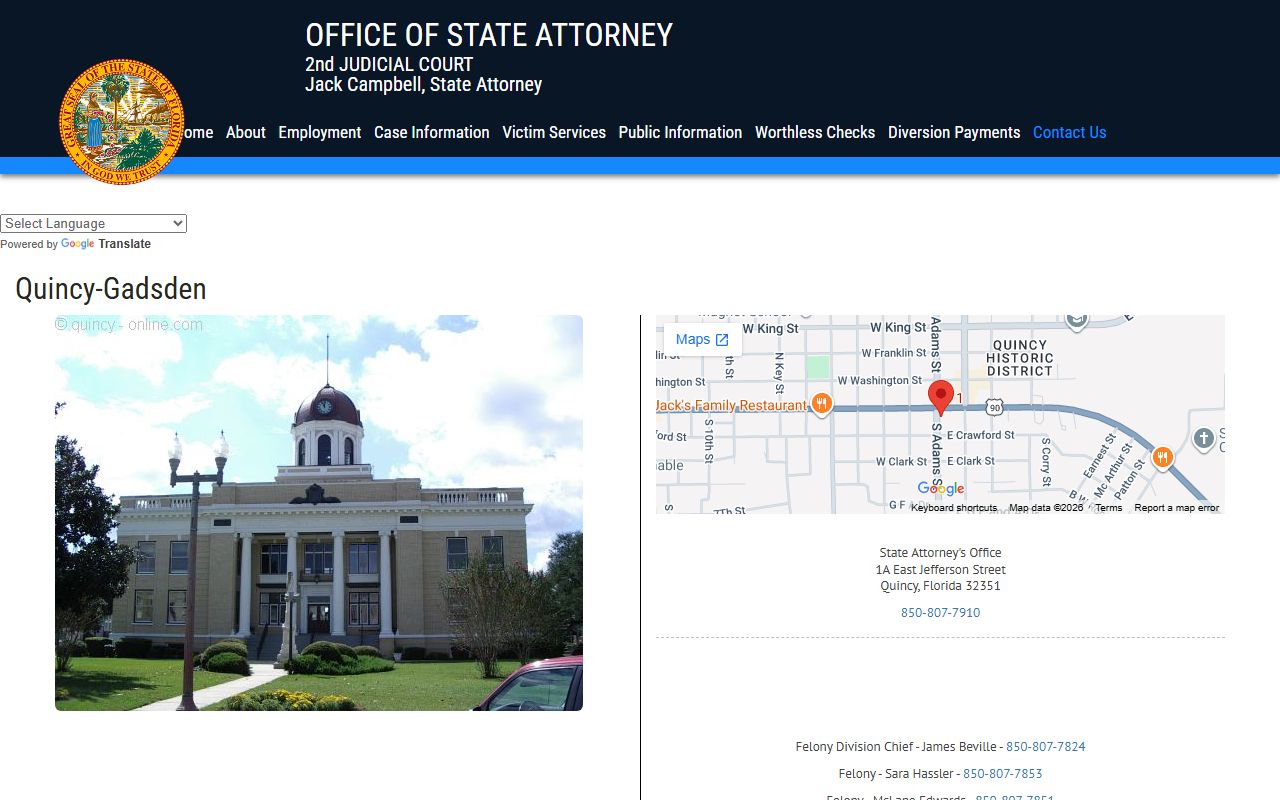
That office decides the charges, but the clerk holds the case file, so a records search for a docket usually starts with the clerk, not the prosecutor.
Charge Status and What It Means After an Arrest
Charges are not fixed once an arrest happens. As a case moves, a charge can be amended, reduced, added, dropped, or dismissed. The booking charges on the jail roster can differ from what the prosecutor finally files, and the court record is the place that tracks those changes. The common status terms are worth knowing.
| Status | What It Means |
|---|---|
| Pending | The charge or case is open and not yet finally resolved. |
| Amended / Reduced | The charge was changed or lowered to a lesser offense. |
| Dismissed | The charge was ended by court action. |
| Nolle Prosequi | The prosecutor decided not to pursue the charge. |
One more Florida term shows up often. Adjudication withheld is a disposition where the court withholds a formal finding of guilt under set conditions. It is not the same as a dismissal, and it is not a clean acquittal.
Bond and Release After an Arrest
Bond is set close to the arrest. Under Florida Rule of Criminal Procedure 3.130, first appearance generally happens within 24 hours, and a judge may set or adjust release conditions then. Some charges carry schedule-based amounts. Serious charges, warrants, domestic violence matters, and probation violations may require a judge's decision or a no-bond hold. A listed dollar amount does not guarantee release if another hold is active.
| Bond Type | How It Works |
|---|---|
| Cash Bond | A cash amount is posted directly under court and jail rules. |
| Surety Bond | A licensed bail agent posts the bond for a fee. |
| PR / Own Recognizance | Release on a written promise to appear, with conditions. |
| No-Bond Hold | No release on money alone until a court changes the hold. |
Florida bail is governed by Chapter 903, and section 903.011 addresses pretrial release and the statewide bond schedule framework. To post bond, confirm custody and the exact amount with the jail at 850-875-8844, then check the court record for filed dates. The county courthouse and clerk sit at 10 East Jefferson Street in Quincy, with a clerk phone of 850-875-8601.
Warrants That Lead to an Arrest
An outstanding warrant is a common path to a booking. No official Gadsden County Sheriff active-warrant search was found online during research, so the fallbacks matter. A bench warrant, such as one for failure to appear, is usually tied to an existing court case, which means CourtScribe can show the related case by name or case number. For statewide wanted-person information, FDLE runs a public search that pulls from state crime information and updates every 24 hours, and it warns users not to act on the results themselves.
The Second Judicial Circuit courthouse page gives the local court context that frames how these cases are handled in Gadsden County.
The Second Judicial Circuit Gadsden courthouse page covers the local court that hears these cases.
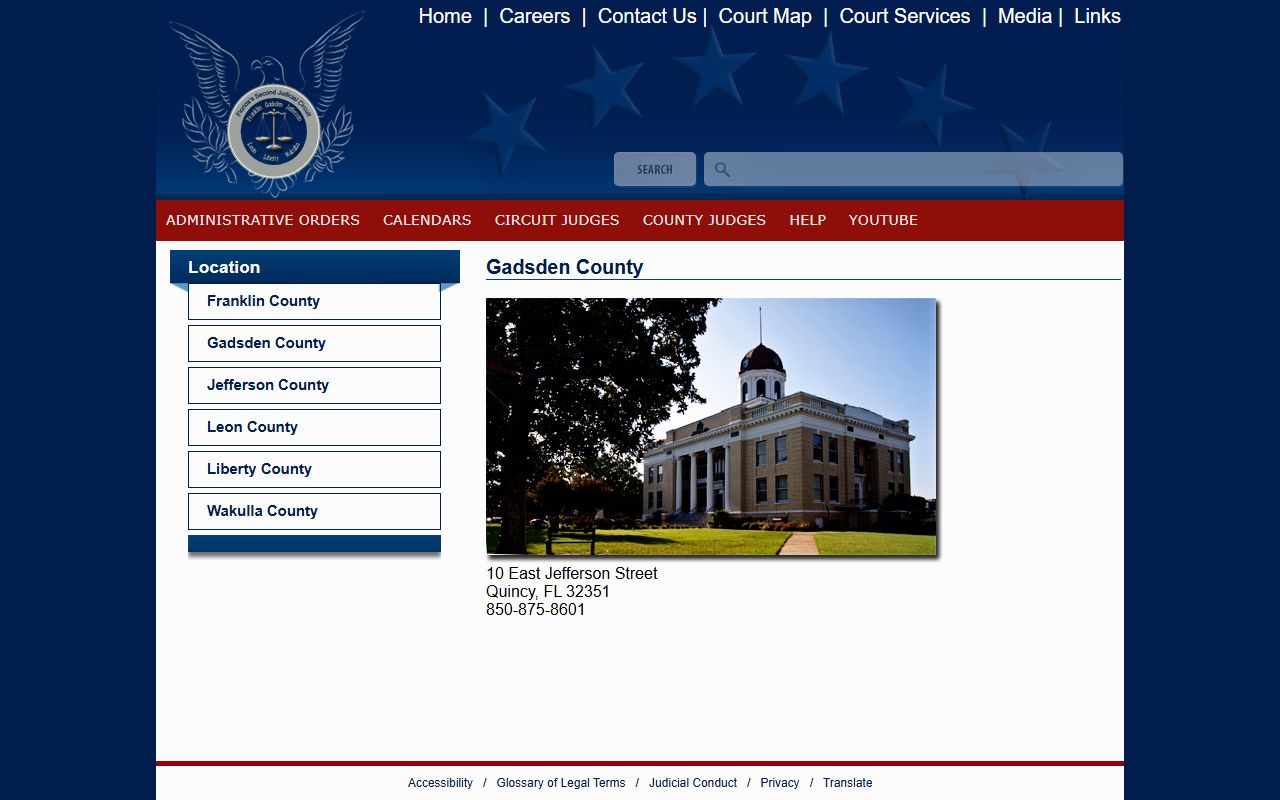
For a local warrant question, the sheriff phone line and a public records request remain the direct routes, since a website alone may not show every active warrant.
Jail Charges vs. Formal Court Charges
The charges that appear at booking are not always the charges that end up in the court record. At the jail, the booking charges are the arrest allegations and custody labels recorded at intake. In the court record, the charges are what the State Attorney formally filed and now manages through the case. The two can match, but they often do not, because the prosecutor reviews the evidence and decides what is actually charged.
This is why a search that stops at the jail roster can mislead. A booking may list one offense, while the filed information lists something more, less, or different. The court record is the authoritative version of the charges, and statewide criminal history through FDLE is yet another product, separate from the live Gadsden case file. When the booking and the court record disagree, the court record controls the legal picture.
Charges vs. Convictions
Being arrested and charged is not the same as being convicted. A charge is an accusation that opens the court record. A conviction is a verdict or a plea that resolves it. Both can be public, but they carry very different weight.
| Charge | Conviction | |
|---|---|---|
| Stage | Accusation | Verdict or plea |
| Burden of Proof | Probable cause | Beyond a reasonable doubt |
| Public Record | Yes | Yes |
This distinction is why a booking record should never be read as proof of guilt. The court record, with its disposition, is the document that shows how a charge actually ended.
Sealed vs. Expunged Arrest Records
After a dismissal or an eligible disposition, a person may be able to clear an arrest record. Florida handles this through sealing and expunction, and the two are not the same. Sealing restricts public access. Expunction goes further toward removal. FDLE generally requires a Certificate of Eligibility before a petition.
| Sealed | Expunged | |
|---|---|---|
| Visibility | Hidden from public view | Destroyed or treated as never existed |
| Law Enforcement | Limited access remains | Very limited access |
| Eligibility | Florida Statutes 943.059 | Florida Statutes 943.0585 |
The FDLE seal and expunge FAQ explains the certificate process. Court files and official records stay public unless an exemption applies, under Florida Statutes 119.0714.
Background Check Considerations
There is a clear line between a casual public-records lookup and a regulated background check. A formal background check for hiring, housing, credit, or insurance is governed by the Fair Credit Reporting Act and must run through a compliant consumer reporting agency. A name search in a court portal is not that.
Important: This site is not a consumer reporting agency under the FCRA, and nothing here may be used for employment, tenant, credit, or insurance screening.
Restricted Court Records After an Arrest in Gadsden County
Not every record after an arrest is open. Juvenile matters, sealed or expunged charges, and active investigations can all be restricted by law. The State Attorney's public-records page also notes that many court documents should be pulled from the clerk first, before a request goes to the prosecutor.
The State Attorney public records request page lists the process and fee schedule for prosecutor-held records.
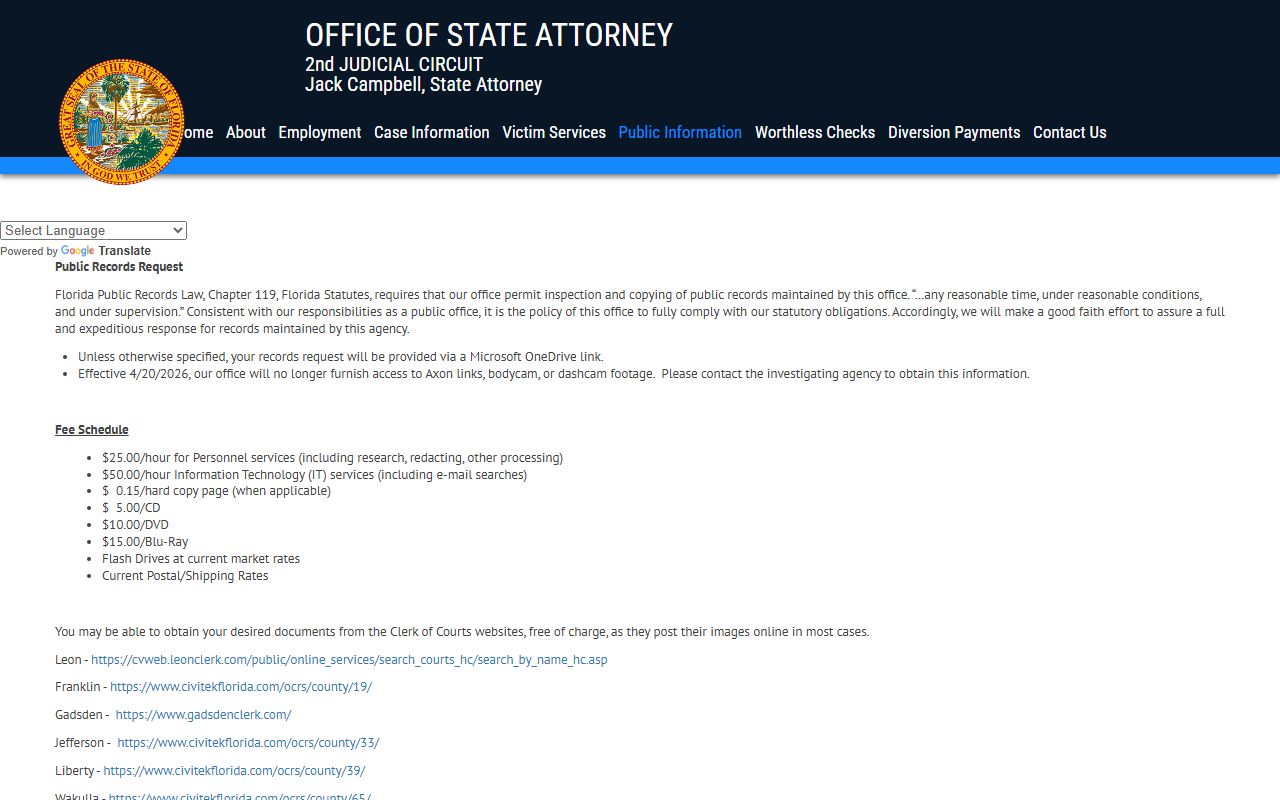
For anything sealed, juvenile, or confidential, the clerk and the issuing office control access, and a website cannot release what the law restricts.